The short answer
Published 2026 podcast sponsorship rates run from about $15 to $40 CPM, with host-read ads at the top and business and finance shows above $40. The last measured market average is older than it looks: $21.37 for a 60-second spot in September 2024, the last month of Libsyn's monthly series we could find. The table further down shows that series month by month, next to the math for a show your size.
Search for podcast sponsorship rates and you get a wall of confident numbers. $18. $25. $15 to $30. $40 and up. Most pages do not say where the number came from, or when it was measured. This article does. Every rate below names the company that published it, the date it was published and what kind of number it is. The links are in the sources list at the end. We read every source again on 26 November 2026. Then we show the math for a show your size, so you can set a rate before a sponsor sets it for you.
What are podcast sponsorship rates in 2026?
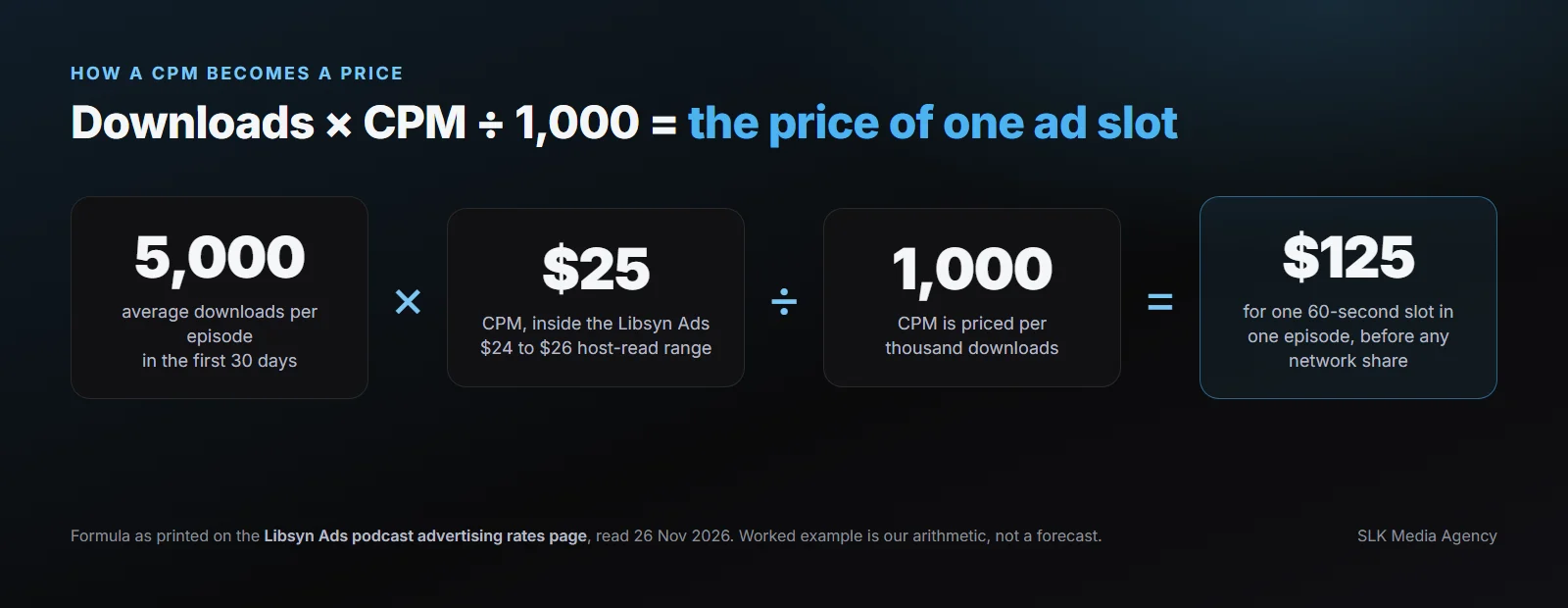
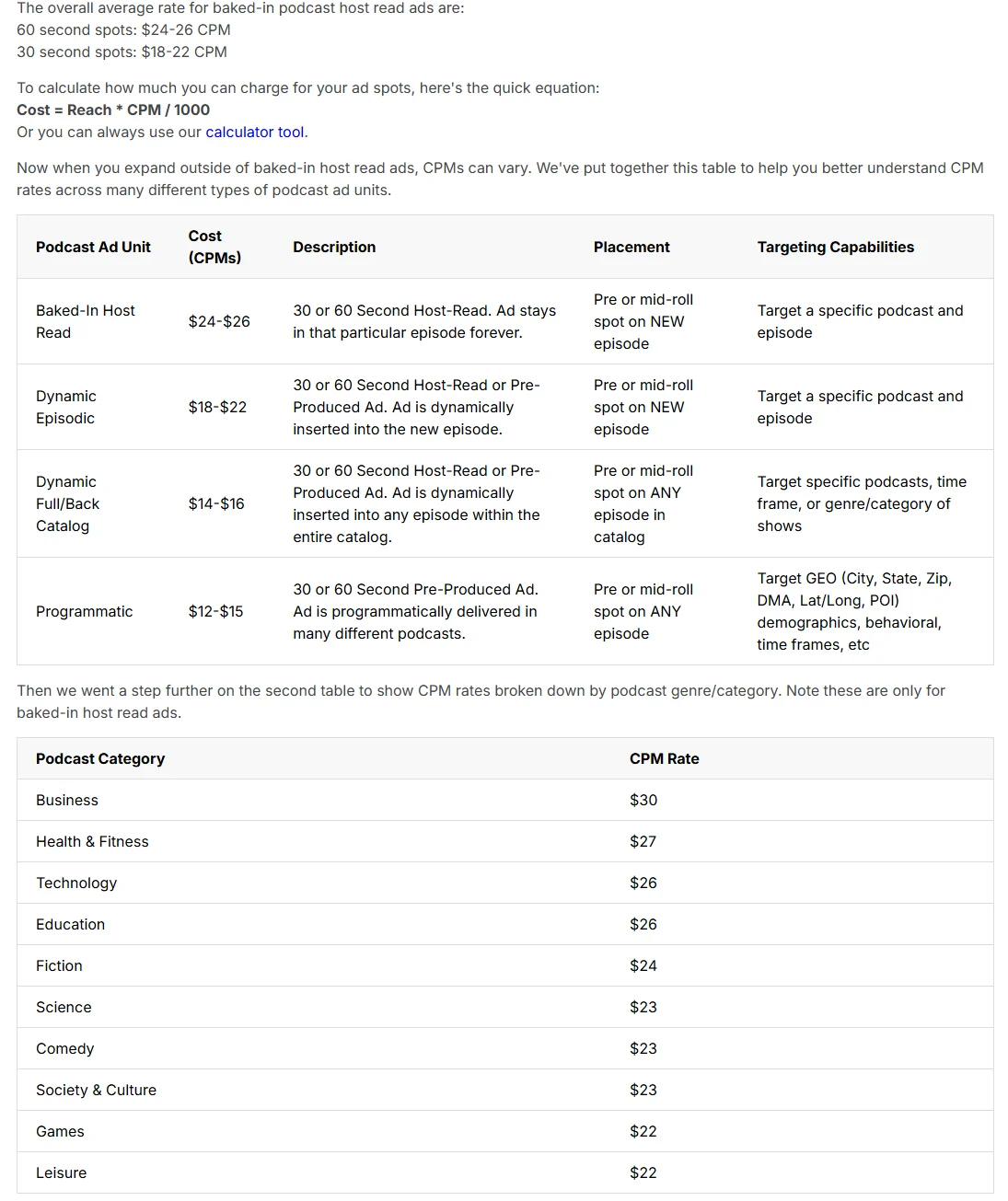
Most podcast ad rates are quoted as a CPM. CPM stands for cost per mille, the price an advertiser pays for every 1,000 downloads or listens of the episode that carries the ad. You will also see it written as cost per thousand listeners or cost per thousand impressions. The formula is simple, and Libsyn Ads prints it on its own rate page: cost = reach × CPM / 1,000.
Here is what the main published sources say about the industry standard CPM today:
- Libsyn Ads (formerly AdvertiseCast): its rate page puts baked-in, host-read ads at $24 to $26 CPM for a 60-second spot and $18 to $22 CPM for a 30-second spot. The page carries no date. Its footer says 2026.
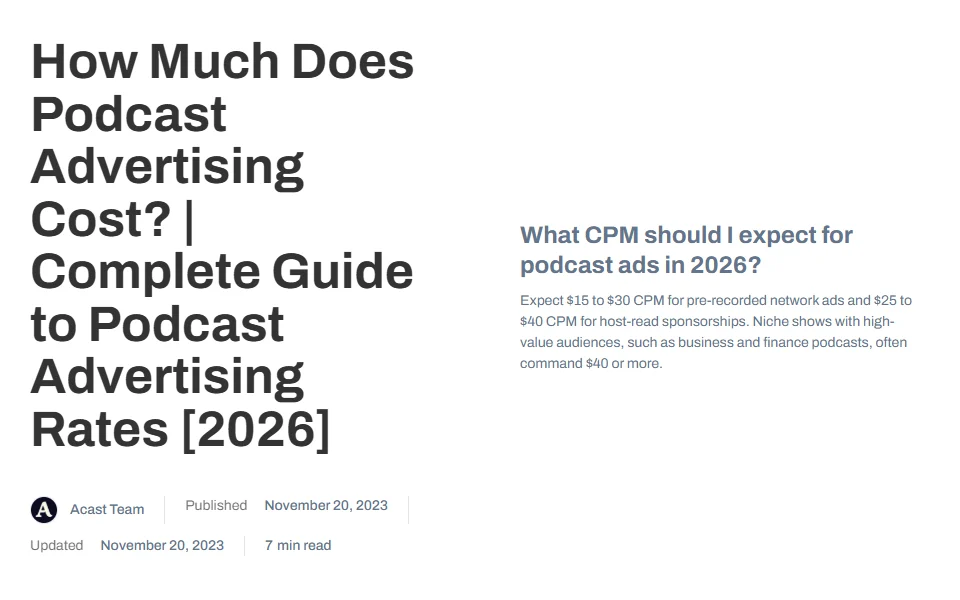
- Acast: its guide says $15 to $30 CPM for pre-recorded ads up to 60 seconds and $25 to $40 CPM for host-read sponsorships, with business and finance shows at $40 or more. The page is titled 2026 but shows a publish date of 20 November 2023.
- Buzzsprout: its sponsor guide of 13 January 2026 calls $18 for a 30-second pre-roll and $25 for a 60-second mid-roll the current industry standard. It does not say where those figures come from.
Those are the figures these pages show today. Libsyn Ads calls its range the "overall average rate", but the page gives no date and no method. None of the three says it was measured from a set of real ad sales in a stated month. That is the most useful thing to know before you price anything, so the next section explains it.
Where does the last measured average come from?
For years, one company published a monthly CPM average built from real ad sales. AdvertiseCast, later renamed Libsyn Ads, posted the prior month's average every month. Libsyn described the figures as "derived from actual sales data across Libsyn Ads' network of thousands of shows". That is not a survey or a forecast. It is what advertisers paid.
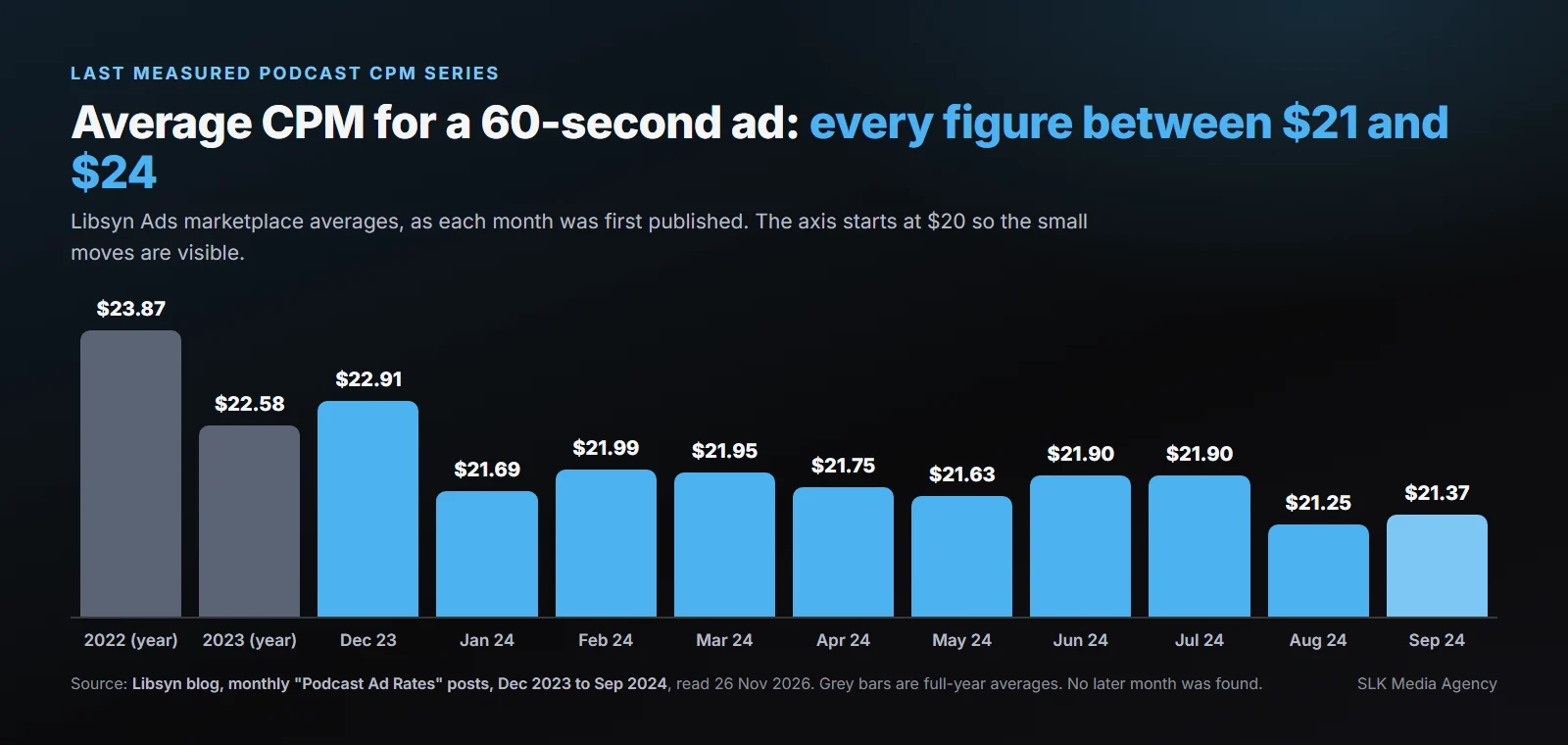
The last monthly post we could find covers September 2024. It reports an average CPM of $21.37 for a 60-second ad spot, against $22.84 in September 2023. Libsyn's blog now marks that post: "This content has been archived. It may no longer be relevant". We looked for October 2024 and later months at the same address pattern, and those pages do not exist. The September post says historical data back to 2020 sits on "the Libsyn Ads site". That link now opens the standing rate page, which shows price ranges and no monthly figures. Castos reached the same conclusion in its own rate guide of 9 September 2026: nothing has replaced the series.
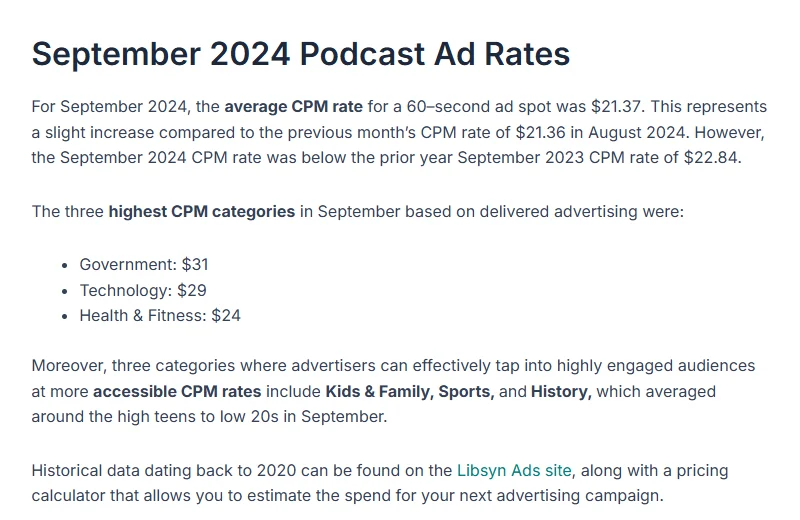
Ten of those monthly posts are still online, from December 2023 to September 2024. We read every one. Here is the series as each month was first published:
| Month | Average CPM, 60-second spot | Three highest CPM categories that month |
|---|---|---|
| Full year 2022 | $23.87 | Not given in the post |
| Full year 2023 | $22.58 | Not given in the post |
| December 2023 | $22.91 | Arts $26, Technology $25, Health & Fitness $24 |
| January 2024 | $21.69 | Technology $26, Arts $26, Education $24 |
| February 2024 | $21.99 | Technology $27, Education $25, Arts $25 |
| March 2024 | $21.95 | Technology $28, Education $24, Health & Fitness $24 |
| April 2024 | $21.75 | Technology $27, Education $25, Comedy $24 |
| May 2024 | $21.63 | Technology $27, Business $25, Education $24 |
| June 2024 | $21.90 | Technology $29, Business $24, Education $24 |
| July 2024 | $21.90 | Technology $30, Government $26, Business $23 |
| August 2024 | $21.25 | Government $29, Technology $29, Health & Fitness $24 |
| September 2024 | $21.37 | Government $31, Technology $29, Health & Fitness $24 |
Source: Libsyn blog, monthly "Podcast Ad Rates" posts for December 2023 to September 2024, published 3 January 2024 to 1 October 2024. The full-year 2022 and 2023 figures come from the December 2023 post. All read 26 November 2026.
Two things stand out. First, the average barely moved. Across ten months it stayed between $21.25 and $22.91. Second, later posts quote different figures for the same month. The August 2024 post reported $21.25. One month later the September post called the August figure $21.36. January was $21.69 in its own post and $21.61 in the next one. April was $21.75 in its own post and $21.89 in the next one. Even a measured average moved by cents from one post to the next. Treat any single CPM figure as the middle of a range, never as a fixed price.
Why do the published rates disagree?
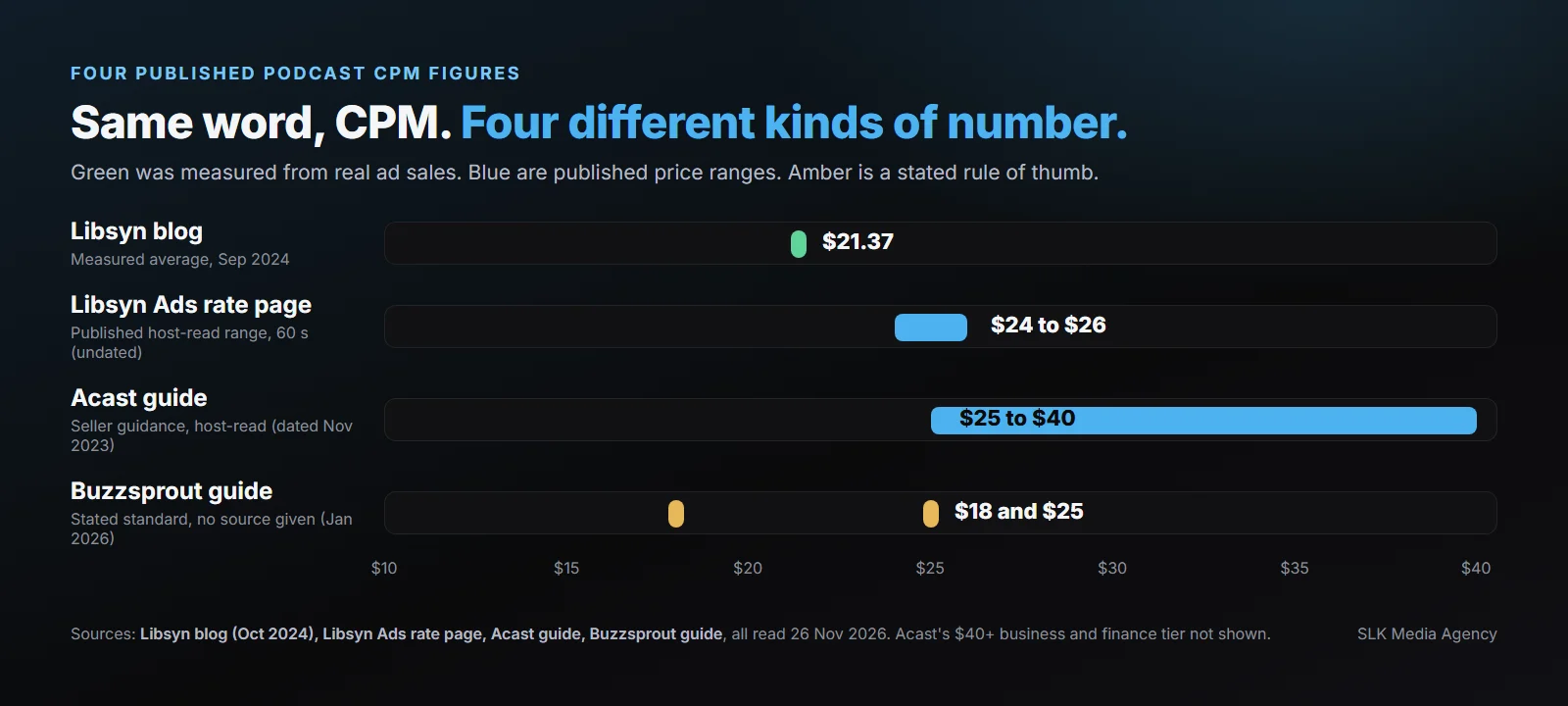
Because they measure different things. A seller's planning guide, a marketplace average and a host's blog post can all say "CPM" and still mean different numbers. Before you quote any figure to a sponsor, check which kind it is.
| Source | What it says | What kind of number it is | Date |
|---|---|---|---|
| Libsyn blog | $21.37 average CPM, 60-second spot | Measured average from ads sold in one marketplace | September 2024 data, posted 1 Oct 2024 |
| Libsyn Ads rate page | $24 to $26 (60 s) and $18 to $22 (30 s), baked-in host-read | A marketplace's published price ranges | No date on the page |
| Acast guide | $15 to $30 pre-recorded, $25 to $40 host-read, $40+ business and finance | A seller's planning guidance for advertisers | Published 20 Nov 2023, titled 2026 |
| Buzzsprout guide | $18 (30 s pre-roll) and $25 (60 s mid-roll) | A host's stated standard, no source given | 13 Jan 2026 |
All four pages read on 26 November 2026. Links are in the sources list at the end of this article.
Look closely and the sources even disagree with themselves. Acast's body text gives $15 to $30 for pre-recorded ads. An FAQ answer lower on the same page says "The average CPM of podcast ads is between $15 to $50". The category tables disagree too. The Libsyn Ads rate page ranks Business first at $30, then Health & Fitness at $27, then Technology and Education at $26. The September 2024 post ranked Government first at $31, then Technology at $29 and Health & Fitness at $24. Both come from the same company. One is a standing price list, the other is one month of delivered ads.
None of this makes the sources useless. It tells you how to use them. The measured Libsyn average is the honest midpoint from 2024. The Libsyn Ads and Acast ranges show where sellers set prices today. Buzzsprout's figures are a rule of thumb. Your rate should sit somewhere inside that span, and your own show's data decides where.
How are podcast sponsorship rates calculated?
The base is always the same: downloads per episode times CPM, divided by 1,000. The Libsyn Ads rate page adds one detail that matters. It prices on "the amount of downloads/impressions the podcast receives in the first 30 days". So the number to use is your average downloads per episode in the first 30 days after release, not your lifetime total.
Here is the math for one 60-second ad slot in one episode. These are prices an advertiser pays, before any share a network or platform keeps.
| Downloads per episode (first 30 days) | At $15 CPM | At $21.37 CPM | At $25 CPM | At $40 CPM |
|---|---|---|---|---|
| 500 | $7.50 | $10.69 | $12.50 | $20.00 |
| 1,000 | $15.00 | $21.37 | $25.00 | $40.00 |
| 5,000 | $75.00 | $106.85 | $125.00 | $200.00 |
| 10,000 | $150.00 | $213.70 | $250.00 | $400.00 |
| 25,000 | $375.00 | $534.25 | $625.00 | $1,000.00 |
Our arithmetic: downloads × CPM / 1,000 for one ad slot. $15 is the low end of Acast's pre-recorded range, $21.37 is the last Libsyn measured average, $25 is Buzzsprout's 60-second mid-roll standard and sits inside Libsyn Ads' $24 to $26 host-read range, and $40 is where Acast places business and finance shows. This is math, not a forecast of what any show will be paid.
Two slots in one episode double the line. Weekly episodes multiply it by four or five a month. That is how a sponsorship rate turns into monthly ad revenue.
What moves a podcast ad rate up or down?
The sources agree on the levers, even when they disagree on the dollar figures.
Who reads the ad
A host-read ad is the host speaking about the product in their own words. A pre-recorded ad is produced by the brand and dropped into the episode. Every source above prices host-read higher. Acast describes host-read sponsorships as "longer, editorialized commercial messages delivered by the podcasters themselves", usually 60 seconds but sometimes "a couple of minutes". Nielsen gave one reason advertisers pay the gap. In October 2020 it reported that host-read ads produced "an average of 50% increase in purchase and recommendation intent" compared with ads the host did not read.
Where the ad is placed
A pre-roll ad plays at the start, a mid-roll ad in the middle and a post-roll ad at the end. Buzzsprout calls mid-roll the most expensive placement "because listener engagement tends to be the highest mid-episode", and says post-roll is less common. Acast also calls mid-roll the most expensive ad slot, and adds two rules from its own platform: a mid-roll needs an episode "at least 10 minutes in length", and a podcaster can move a pre-roll "up to 25% into an episode".
How the ad is delivered
The Libsyn Ads rate page lists four ad units with different prices:
| Ad unit | CPM on the Libsyn Ads rate page | What it is |
|---|---|---|
| Baked-in host read | $24 to $26 | Host-read ad that stays in that episode forever |
| Dynamic episodic | $18 to $22 | Ad inserted into a new episode by dynamic ad insertion |
| Dynamic full or back catalog | $14 to $16 | Ad inserted into any episode in the catalog |
| Programmatic | $12 to $15 | Pre-produced ad delivered across many podcasts |
Source: Libsyn Ads, Podcast Advertising Rates page, read 26 November 2026. The page shows no date.
Dynamic ad insertion means the ad is stitched into the file when someone downloads it, so the same episode can carry a different ad next month. That is why a back catalog can earn too, at a lower rate.
Your niche and your listeners
Category moves the rate because of what the advertiser sells, not because one show is better than another. Acast puts it plainly: a company selling farming equipment would rather reach "the right audience on an industry-specific podcast" than advertise on a big general show. A niche podcast with a clear audience can charge more per thousand than a larger general one. Know your listener demographics from your host and from Spotify and Apple Podcasts before you set a number.
Targeting
For network campaigns, Acast says a basic campaign with only country-level targeting "will cost around $15 CPM", and the CPM rises as an advertiser adds regions, categories or audience segments.
CPM, flat rate or affiliate: which pricing model fits your show?
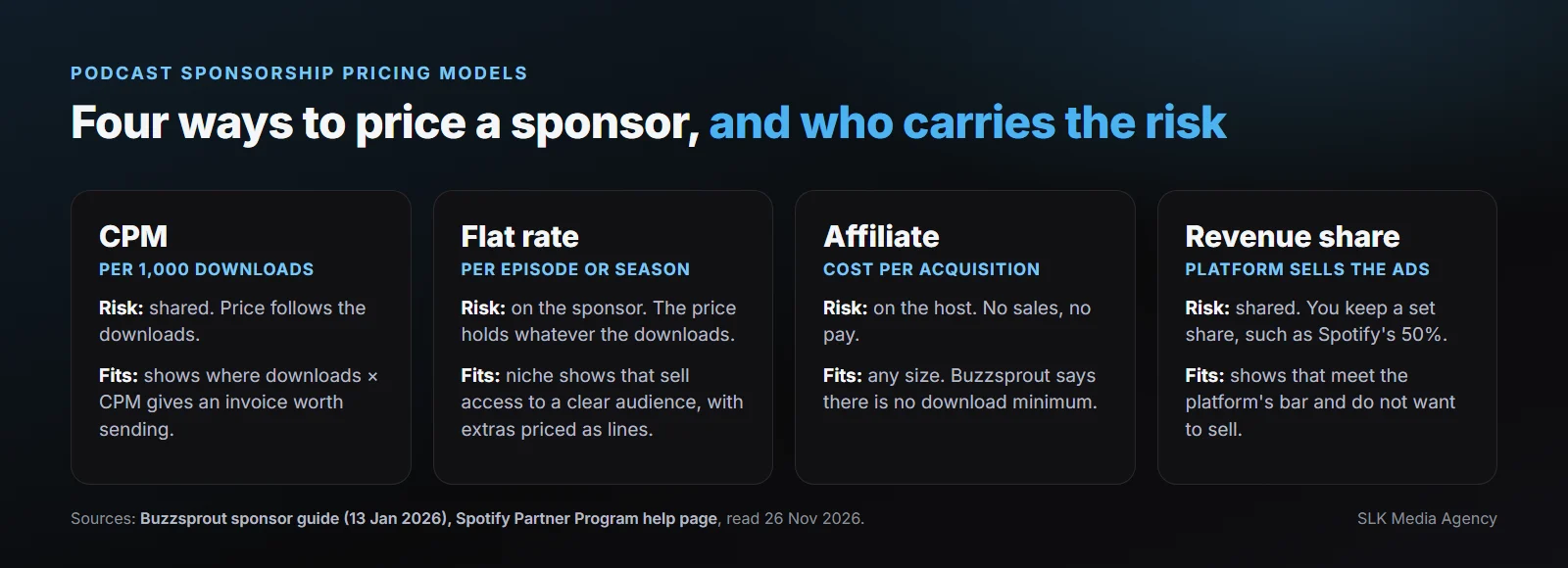
CPM is the default, but it is not the only way to price a podcast sponsorship. There are three common sponsorship formats, plus a fourth route that comes from the platform itself.
- CPM. The sponsor pays per thousand downloads. It is fair to both sides and easy to check. It works best once the math in the table above produces an invoice worth sending.
- Flat rate per episode. One fixed price per episode or per season, whatever the downloads. No public source we found publishes measured flat fees for small shows, so build yours from the CPM math and add what else the sponsor gets: a link in the show notes, a mention in your newsletter, a post on your social accounts. Price each of those as a line, so the sponsor sees what the fee buys.
- Affiliate, or cost per acquisition. You earn a commission when a listener buys through your link or promo code. Buzzsprout says "There are no download requirements to start affiliate marketing", and calls it one of the easiest ways to get a first sponsor. The risk sits with you: no sales, no pay.
- A platform revenue share. You let a platform sell and insert the ads, and you take a share. See the Spotify section below.
Many sponsorship deals mix these. A small flat fee plus a promo code gives the sponsor a way to measure return on investment, and gives the host a floor.
How many downloads do you need to attract sponsors?
There is no single threshold, and anyone who gives you one number is guessing. Here is what the sources actually say:
- Buzzsprout says it is "not profitable to seek a sponsorship deal unless you consistently have at least 200 downloads per episode".
- Buzzsprout says joining a podcast network is best for shows with "5,000-10,000+ downloads per episode".
- For affiliate deals, Buzzsprout says there is no download minimum.
- For the Spotify Partner Program, the bar is set in consumption hours and audience count on Spotify, not downloads. Details below.
Our table above shows why small shows rarely sell on CPM alone. At 500 downloads an episode and $21.37 CPM, one slot comes to $10.69. At that size, a CPM deal is hard to justify on reach alone, so the pitch has to rest on who listens. If you want to know how your numbers compare, we built a dated table of download benchmarks in How many downloads is good for a podcast?
Do podcast networks and platforms take a cut?
Yes. The CPM a sponsor pays and the amount a host receives are different numbers. Buzzsprout says networks "want a cut of your ad revenue (usually around 30%)". The share varies by network, so read the agreement before you sign.
Spotify publishes its share. Under the Spotify Partner Program, a creator earns "a 50% share of the revenue recognized every time an ad monetized by Spotify (as part of the Spotify Partner Program) plays in your episodes". You choose your own ad breaks, and you need at least one ad break in an episode to earn ad revenue.
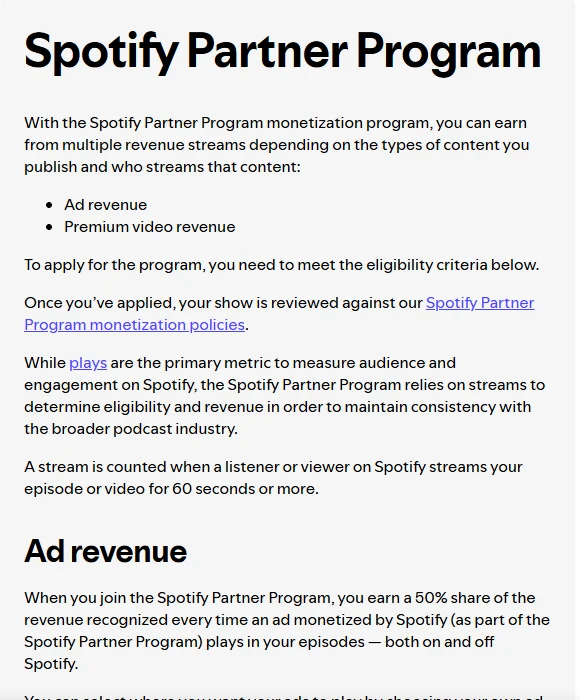
To apply, Spotify's help page lists these criteria, as read on 26 November 2026:
- Host your show on Spotify for Creators.
- Have a legal address in one of the eligible markets, which include the United States, Canada, the United Kingdom and Australia.
- Have published at least 3 episodes.
- Hit at least 2,000 consumption hours on Spotify in the last 30 days.
- Hit at least 1,000 audience count on Spotify in the last 30 days.
To stay in, a show must publish an episode and earn at least $10 in any 6-month period. Spotify also pays "Premium video revenue" for video episodes streamed by Premium members in select markets, through its own formula. A platform share and a direct sponsor are not either-or for every show, but check each contract for exclusivity before you combine them.
What do sponsors get in return?
A sponsor pays for three things: the ad read, the audience hearing it, and proof that it worked. Spell out all three on your rate card.
- The read. Length (30 or 60 seconds), placement (pre-roll, mid-roll or post-roll), host-read or pre-recorded, and whether it stays in the episode for good or runs for a set period.
- The audience. Average downloads per episode in the first 30 days, who your listeners are, and what they care about.
- The proof. A promo code, a tracked link in the show notes, or both. If the sponsor wants sales, give them a way to count the sales.
Keep ads in proportion. Buzzsprout advises against reading ads for more than 10% of an episode's length. A sponsor wants your listeners to trust you, and too many ad breaks cost you that trust.
How do you get ads on your podcast?
There are four routes, roughly in order of how much work they take:
- Turn on a platform program. If your host offers one, such as the Spotify Partner Program, the platform finds the advertisers. You give up a share and some control.
- Join an ad marketplace or podcast network. The network sells your ad space for you and keeps a cut. Most expect a minimum audience.
- Start with affiliate programs. No download minimum, and a promo code gives you your own conversion data for the next pitch.
- Pitch potential sponsors directly. Make a short list of brands your listeners already use. Send a one-page media kit with your numbers and a rate card. Direct deals keep the whole fee, but you do the selling.
Direct deals keep the whole fee, so they pay best per deal. They also take the most preparation: a media kit, a rate card and a short list of brands to pitch.
How do you negotiate a higher rate?
Bring numbers the sponsor cannot argue with. If a first offer sits at the bottom of the published ranges, your answer is your own data, not a better adjective.
- Price on the right window. Quote average downloads in the first 30 days, as the Libsyn Ads page does. Do not quote a lifetime figure.
- Show your category. If your show sits in a high-CPM category in the tables above, say so and cite the source.
- Offer host-read mid-roll. It is the format every source prices highest.
- Sell packages, not single spots. A run of episodes, plus show notes and newsletter mentions, gives the sponsor time to see results and gives you a bigger single deal.
- Report after the run. Send downloads, promo code uses and link clicks. Proof of sponsorship performance is what turns a one-off into a renewal at a higher rate.
Is podcast advertising still growing?
Yes, at the market level. The IAB and PwC Internet Advertising Revenue Report for full year 2025, published in April 2026, puts US podcast advertising revenue at $2,862.2 million in 2025, up 17.6% from $2,433.1 million in 2024. The same report notes that its figures use the traditional, audio-based definition of a podcast, while video "becomes the leading channel for podcast consumption".
A growing market does not set your rate. It does mean advertisers keep buying podcast ad space, and the shows that can show who listens are the ones they buy from.
Rates in this article are quoted from each company's own pages as read on 26 November 2026. Rate pages change without notice, so check the linked page before you rely on a figure. The earnings tables are arithmetic on published rates, not a prediction of what any show will be paid.
Frequently asked questions
What is a good CPM rate for a podcast?
The last measured marketplace average was $21.37 for a 60-second ad in September 2024, from Libsyn. Published 2026 ranges sit around it: Libsyn Ads lists $24 to $26 for a 60-second host-read ad, and Acast gives $15 to $30 for pre-recorded ads and $25 to $40 for host-read sponsorships. A rate near the middle of those ranges is defensible. Your category and your own data decide where you sit.
How are podcast sponsorship rates calculated?
Downloads per episode times the CPM, divided by 1,000. Libsyn Ads prices on downloads in the first 30 days after release. So 5,000 downloads at a $25 CPM comes to $125 for one ad slot in one episode, before any share a network or platform keeps.
How much does a podcast with 10,000 downloads make from one ad?
At the September 2024 average of $21.37 CPM, one 60-second slot in an episode with 10,000 downloads comes to $213.70. At $25 CPM it is $250, and at $40 CPM it is $400. That is what the advertiser pays. A network or platform may keep a share.
How many downloads do you need to get podcast sponsors?
There is no single threshold. Buzzsprout says a sponsorship deal is not worth chasing below about 200 downloads per episode, and that networks suit shows with 5,000 to 10,000 or more. Affiliate deals have no download minimum. The Spotify Partner Program uses consumption hours and audience count on Spotify instead of downloads.
Do podcast networks take a cut of ad revenue?
Yes. Buzzsprout says networks usually take around 30%, and the share varies by network. Under the Spotify Partner Program, the creator earns a 50% share of the revenue from ads Spotify sells into the episodes.
Should I charge CPM, a flat rate or use affiliate deals?
CPM suits shows whose downloads produce an invoice worth sending. A flat rate per episode or season suits niche shows selling access to a clear audience; build it from the CPM math and price extras such as show notes links and newsletter mentions as separate lines. Affiliate deals have no minimum but pay only when listeners buy.
What do sponsors get in return?
The ad read itself (length, placement, host-read or pre-recorded), the audience that hears it, and a way to measure results, usually a promo code or a tracked link. Buzzsprout advises keeping ads under 10% of an episode's length.
Sources
- Libsyn blog: September 2024 Podcast Ad Rates. Average CPM $21.37 for a 60-second spot, August $21.36, September 2023 $22.84, top categories Government $31, Technology $29, Health and Fitness $24. Posted 1 October 2024, now marked archived. Read on 26 November 2026
- Libsyn blog: monthly Podcast Ad Rates posts, December 2023 to August 2024. Eight more monthly posts at the same address pattern (january-2024 to august-2024). Monthly averages and top categories, plus full-year 2022 ($23.87) and 2023 ($22.58) averages in the December 2023 post. Read on 26 November 2026
- Libsyn Ads: Podcast Advertising Rates. Host-read 60 s $24 to $26 and 30 s $18 to $22, the four ad unit ranges, the category table and the cost = reach x CPM / 1000 formula. The page shows no date; footer 2026. Read on 26 November 2026
- Acast: How Much Does Podcast Advertising Cost? Complete Guide to Podcast Advertising Rates [2026]. Pre-recorded $15 to $30, host-read $25 to $40, business and finance $40+, basic network campaign around $15, pre-roll and mid-roll rules, FAQ figure of $15 to $50. Page shows published and updated 20 November 2023. Read on 26 November 2026
- Buzzsprout: How to Get Podcast Sponsors [2026]. 200 downloads per episode, networks for 5,000 to 10,000+ and their cut of around 30%, $18 and $25 stated standard, affiliate with no download minimum, 10% ad time. Published 13 January 2026. Read on 26 November 2026
- Spotify for Creators: Spotify Partner Program. 50% ad revenue share, Premium video revenue, eligible markets, eligibility criteria and the 6-month activity rule. The page shows no date. Read on 26 November 2026
- IAB and PwC: Internet Advertising Revenue Report, Full Year 2025. US podcast advertising revenue $2,862.2 million in 2025, up 17.6% from $2,433.1 million in 2024 (page 24). Published April 2026. Read on 26 November 2026
- Nielsen: Host-read podcast ads pack a brand recall punch. Host-read ads produced an average 50% increase in purchase and recommendation intent compared with non-host-read ads. Published October 2020. Read on 26 November 2026
- Castos: Podcast Advertising Rates in 2026. Reaches the same conclusion that the Libsyn monthly series ended and nothing replaced it. Published 9 September 2026. Read on 26 November 2026

Natalie Nicholas works on the growth team at SLK Media Agency, where the team edits, captions and posts short clips from podcast episodes every week. She writes about the first seconds of a clip: the cut, the frame and the hook.