The short answer
Yes, if AI made audio or video your audience hears or sees, such as a synthetic voice, an AI host or a cloned voice: Apple Podcasts asks for a disclosure in every episode and the show metadata, while Acast and YouTube ask when the AI part is large or looks real. AI help with scripts, show notes, captions and audio cleanup needs no label on the platforms we read. The table further down puts all five rulebooks side by side, with what each one exempts.
You used AI somewhere in your last episode. Maybe it wrote the outline, cleaned the audio or drafted the show notes. Maybe it read an ad in a synthetic voice. Now you are wondering whether you have to tell your listeners, and where. The answer depends on which platform you are on and which kind of AI use it was. This article puts the AI disclosure rules of Apple Podcasts, Acast, YouTube, Spotify and the EU AI Act side by side, quoted from each one's own page. Every source was read on 26 November 2026.
Do you need to disclose AI in your podcast?
Yes, if AI made audio or video that your audience hears or sees: a synthetic voice, an AI host, a cloned voice or AI footage. Apple Podcasts asks for that disclosure in every episode and in the show metadata. Acast and YouTube ask for it when the AI part is large or looks real. Spotify has no disclosure rule for podcasts, but it removes shows that copy another host's voice without permission.
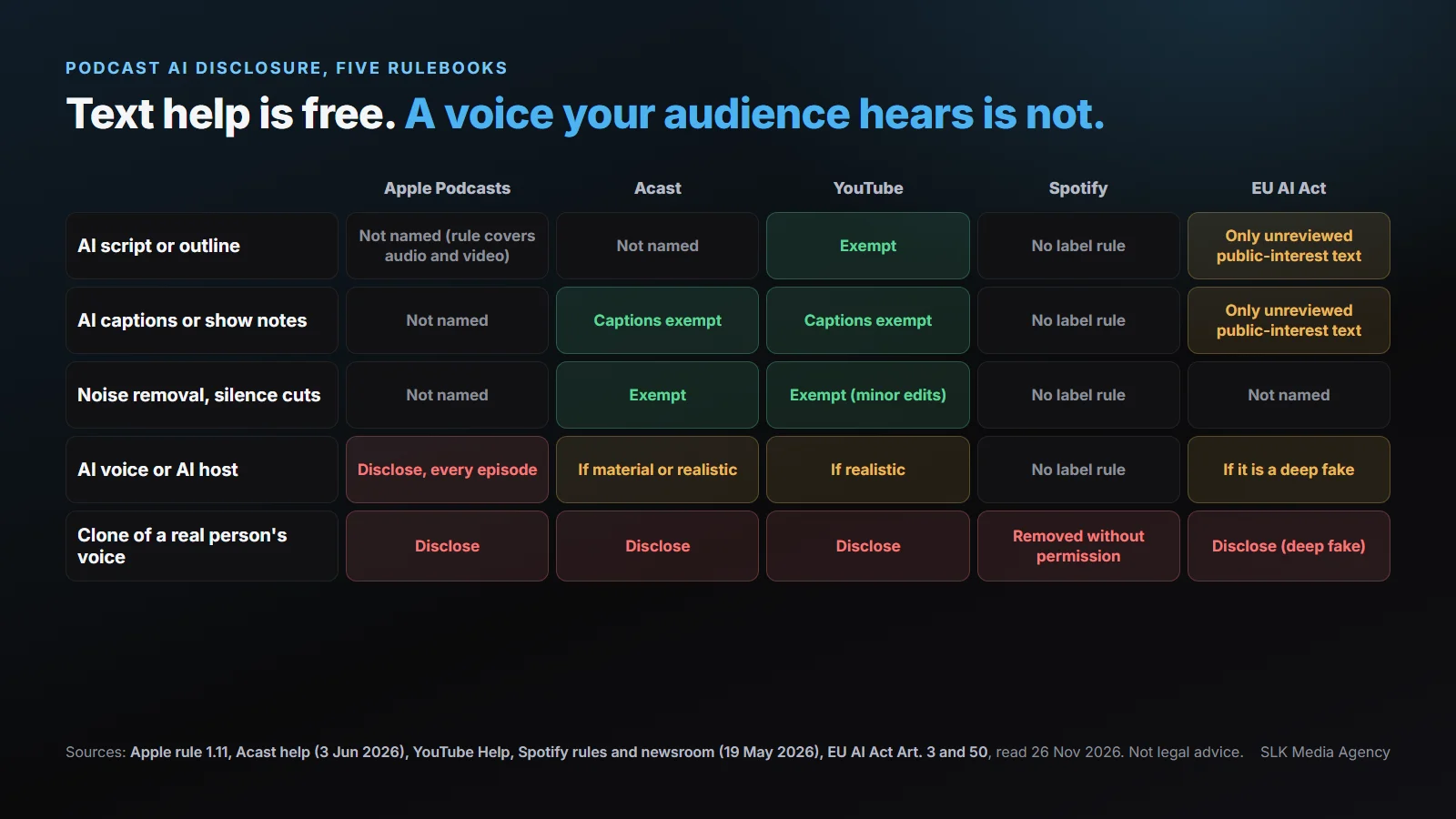
No platform we read asks you to label AI help with text. YouTube lists a script, an outline and captions as exempt. Acast lists captions and audio cleanup as exempt. Here is the full picture.
| Platform or law | Who it covers | What triggers a disclosure | Where it must go | Named as exempt |
|---|---|---|---|---|
| Apple Podcasts, rule 1.11 | Shows listed on Apple Podcasts | Using AI "to generate audio or video content", including synthetic voices, AI hosts and replicas of real people | "in the content and metadata for each episode and show" | Nothing named. The rule covers audio and video, not text |
| Acast | Shows hosted on Acast | AI made "a material portion" of the show, or a smaller part "in a manner that imitates realistic content" | Material portion: the podcast file and the description. Smaller realistic part: the description | Captions, a video background, silence removal, audio enhancement |
| YouTube | Video podcasts and clips on YouTube | AI or altered content that "seems realistic", such as a real person saying something they did not say | The disclosure setting during upload. YouTube then shows a label | A script or outline, captions, ideas, beauty filters, background blur, minor edits |
| Spotify | Shows on Spotify | No disclosure rule found. Impersonating another creator or host without permission gets a show removed | Not applicable | Not applicable |
| EU AI Act, Article 50(4) | Deployers, the Act's word for people who use an AI system to make content | Audio or video that is a "deep fake", and AI text on matters of public interest with no human review | "in a clear and distinguishable manner", at the latest at first exposure | Public-interest text that a person reviewed and takes editorial responsibility for |
Sources: Apple Podcasts Content Requirements; Acast, "Use of AI in podcasting" (dated 3 June 2026); YouTube Help, "Disclosing use of altered or synthetic content"; Spotify Platform Rules and Spotify Newsroom (19 May 2026); EU AI Act Articles 3 and 50. All read 26 November 2026.
What does Apple Podcasts require?
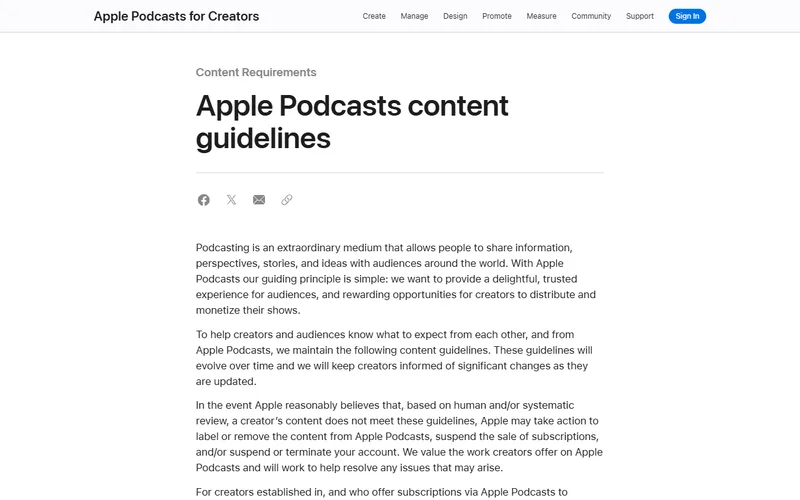
Apple has the widest rule. Rule 1.11 of the Apple Podcasts Content Requirements is titled "Artificial Intelligence (AI) Generated Content". It reads: "Creators using AI to generate audio or video content [...] including synthetic voices, AI-generated hosts or on-screen personas, or AI-synthesized replicas of real individuals [...] must prominently disclose this to audiences in the content and metadata for each episode and show." (The brackets mark words left out of the quote. The rule's own wording is unchanged.)
Three details matter. First, "in the content" means the audio or video itself, not only the episode description. Second, "for each episode and show" means a note in the show description does not cover the episodes. Third, the rule has no size limit. If you have read that Apple's rule covers only a "material portion" of a show, that wording comes from Acast's rule. Apple's text has no such qualifier.
Rule 1.12, "Misleading Use of AI", goes further than disclosure. Creators "must not use AI in violation of these guidelines, including to mislead or deceptively portray real-life events in their content". Apple's examples are using AI "to fabricate news stories or manipulate audio or video clips to present false narratives". A label does not make that allowed.
What does Acast require?
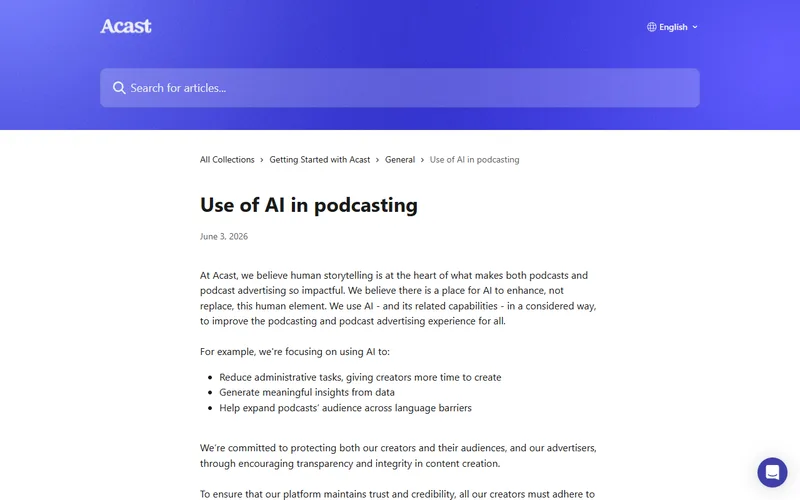
Acast's help article "Use of AI in podcasting" is dated 3 June 2026. It sets two levels.
- A material portion: "If AI is used to generate a material portion of a podcast, you must prominently disclose this in the podcast file and metadata of the podcast (i.e. in the podcast description)." Acast's examples are translating a podcast into another language and replicating a host's voice or image.
- A smaller part that sounds real: "If AI is used to generate a non-material portion of the audio, but is used in a manner that imitates realistic content, you must disclose this in the metadata of the publication (i.e. in the podcast description)." The example is replacing one person's voice with another's.
Acast does not define "material portion". It does say what needs no disclosure: AI-made captions, a generated video background, and production help such as removing silence or improving audio quality. Like Apple, it bans using AI to mislead, for example making a real person appear to say something they did not. Acast says it may remove content that breaks these rules.
What does YouTube require for a video podcast?
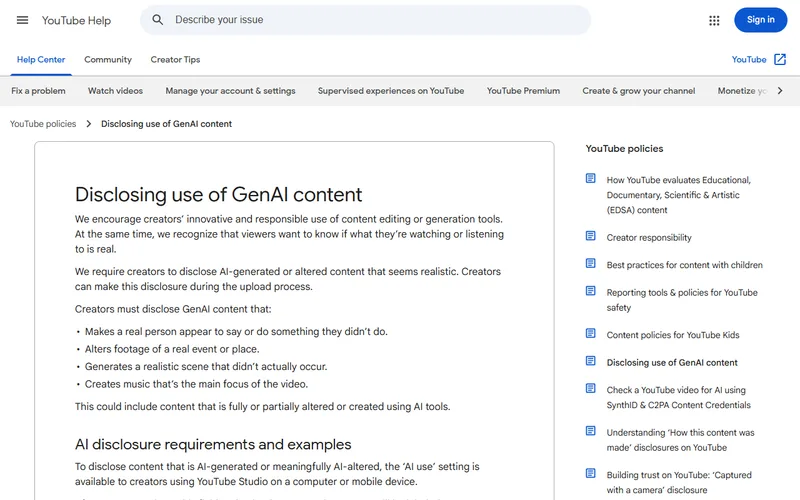
YouTube's rule is about realism. Its help page says creators must disclose AI-generated or altered content that "seems realistic". Two examples it gives: content that "makes a real person appear to say or do something they didn't do", and content that "alters footage of a real event or place". You tick the disclosure setting when you upload.
The exempt list is the useful part for podcasters. YouTube does not require a disclosure for "production assistance, like using generative AI tools to create or improve a video outline, script", for captions, for idea generation, or for effects such as background blur. It also exempts "non-realistic content that's made with AI, or edits to realistic content that are minor".
Where does the label show? For AI music or photorealistic video, it may appear in the video player. For other AI audio, it may appear in the expanded description. Creators who "consistently" fail to disclose may get a label added by YouTube, or penalties including "removal of content or suspension from the YouTube Partner Program". If you post clips there, the separate reused content rules apply too. We covered those in Does YouTube monetize podcast clips?
Does Spotify require AI disclosure for podcasts?
Not in the pages we read. Spotify's Platform Rules have no AI disclosure rule and no AI label for podcasts. They ban two related things. One is "content that impersonates others in order to deceive". The other is "content that promotes manipulated and synthetic media as authentic in ways that pose the risk of harm".
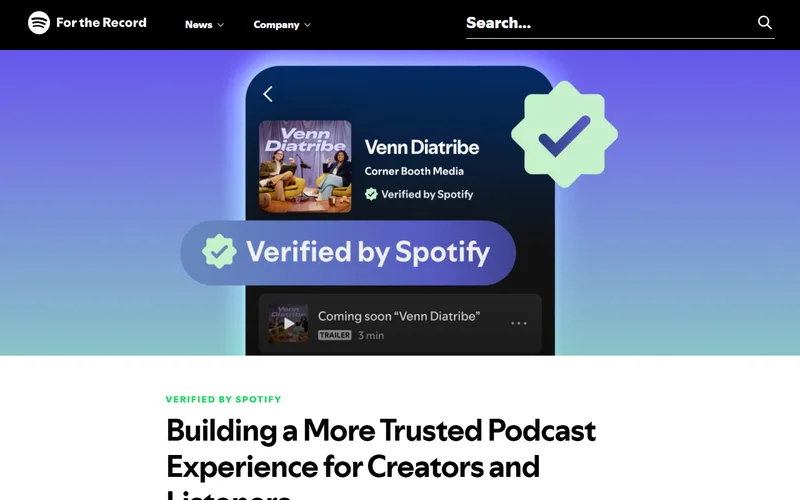
On 19 May 2026 Spotify made the AI part explicit. Its announcement says: "Spotify will remove podcast shows and content that impersonate another creator or host's likeness without permission, whether that's using AI voice cloning or any other method." The same post extended the "Verified by Spotify" badge to podcasts. Spotify says the badge "signals that the show has been reviewed against Spotify's standards for authenticity and trust". Eligibility looks at sustained listener activity, good standing with its policies, and an audience that is not bot traffic.
So on Spotify the question is not whether you labelled the AI. It is whether the voice is yours, or someone gave you permission to use theirs.
What does the EU AI Act say about AI in podcasts?
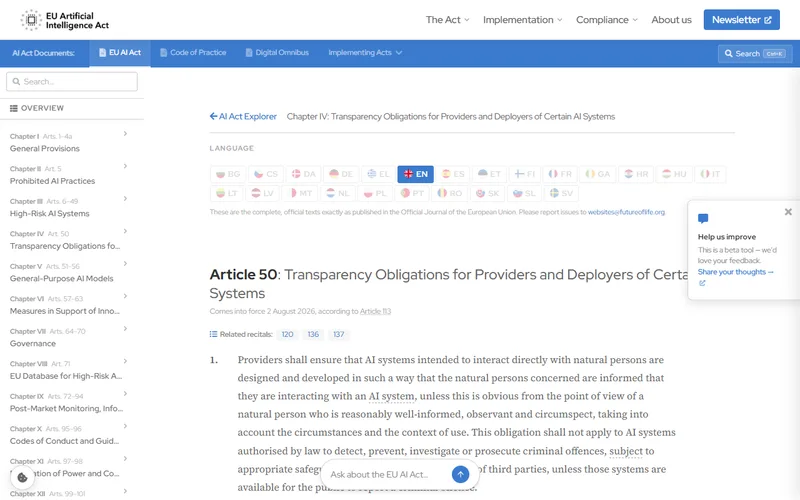
Article 50 of the EU AI Act applies from 2 August 2026. Paragraph 4 covers deployers, the Act's word for people who use an AI system, as opposed to the companies that build it. It says deployers of AI that makes "image, audio or video content constituting a deep fake" must "disclose that the content has been artificially generated or manipulated".
Article 3 defines a deep fake as "AI-generated or manipulated image, audio or video content that resembles existing persons, objects, places, entities or events and would falsely appear to a person to be authentic or truthful". A cloned voice of a real guest fits that wording closely. Whether a made-up AI host voice counts is less clear, and the sources we read do not settle it.
Two more parts of Article 50 matter for shows:
- Creative work: where the content is part of "an evidently artistic, creative, satirical, fictional or analogous work or programme", the duty shrinks to disclosing that such content exists, "in an appropriate manner that does not hamper the display or enjoyment of the work".
- Text: AI text "published with the purpose of informing the public on matters of public interest" must be disclosed, unless it "has undergone a process of human review or editorial control" and a person holds editorial responsibility. If your show notes count as public-interest text at all, notes you edit and take responsibility for look like the exempt side of that line.
Paragraph 5 sets the timing: the information must be given "in a clear and distinguishable manner at the latest at the time of the first interaction or exposure". For a podcast, that points to the start of the episode, not the end. Goodwin Procter's August 2026 alert puts the fines for breaking Article 50 at up to EUR 15 million or 3% of worldwide annual turnover, whichever is higher.
Which AI uses need a disclosure?
Sort every AI use in your production by one question first: did the AI make sound or pictures that your audience takes in, or did it help you with text and cleanup? The flow below follows the rules quoted above.
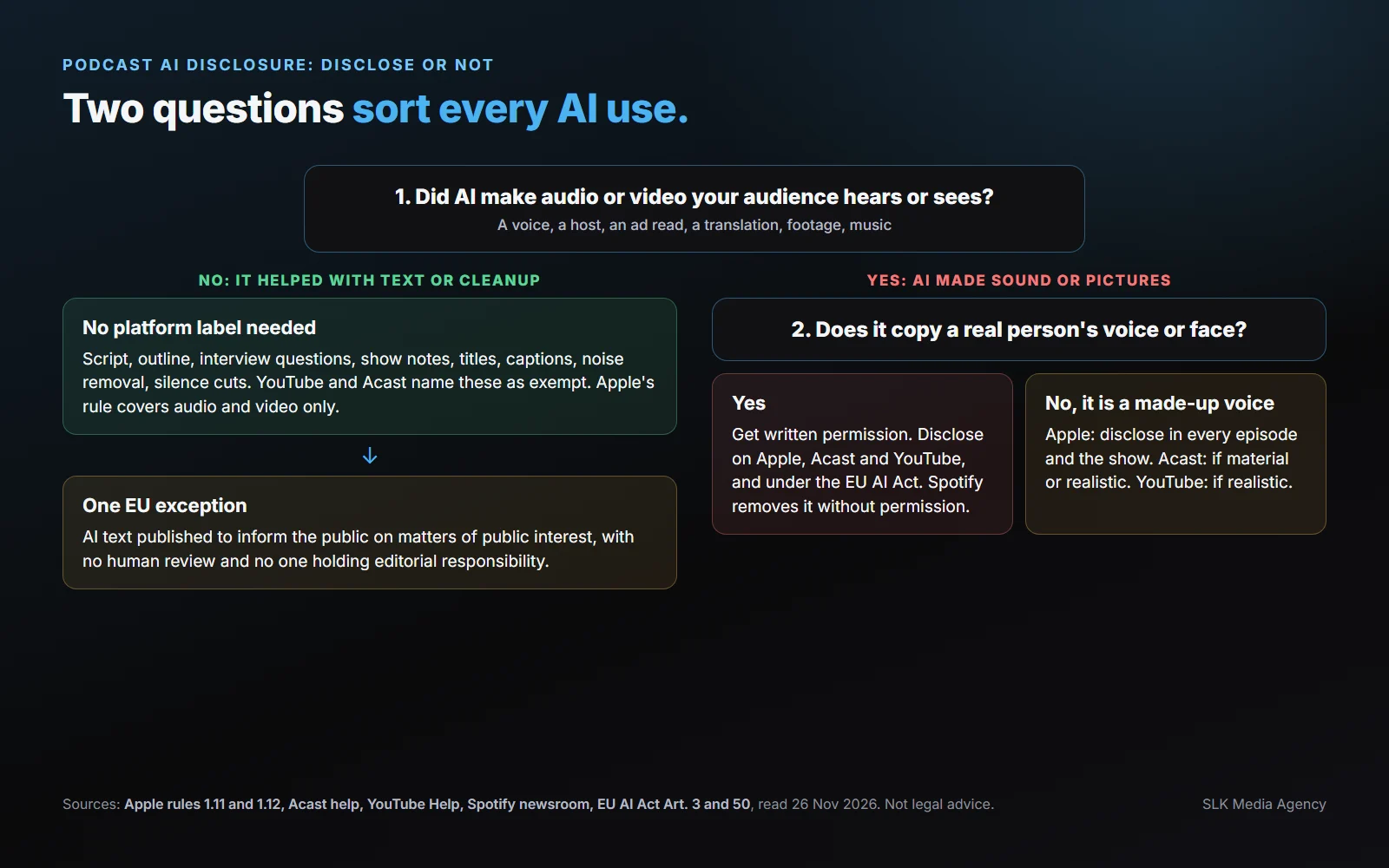
Here is how common AI uses come out:
- An AI-drafted outline, script or interview questions: no label on YouTube or Acast. Apple's rule names audio and video, not text. If AI writes the words and a synthetic voice reads them, the voice needs the disclosure.
- AI show notes, titles and captions: no label. YouTube and Acast name captions as exempt. Under the EU rule, text you review and publish under your name is exempt.
- Noise removal, silence cutting, audio repair: no label. Acast names these. YouTube exempts minor edits.
- An AI host, an AI co-host or a synthetic ad read: disclose on Apple in every episode. On Acast when it is a material portion or sounds real. On YouTube when it seems realistic.
- A clone of your own voice: disclose on Apple, Acast and YouTube. It is your voice, so Spotify's impersonation rule is not the issue.
- A clone of a guest's or another host's voice: get written permission first. Without it, Spotify says it will remove the show. Apple and Acast ban using AI to mislead, and YouTube requires a disclosure for AI-generated or altered content that "seems realistic". One of its examples is content that makes a real person appear to say something they did not.
- An AI translation of the episode: Acast lists it as an example that must be disclosed. Apple's rule covers it when the translated voice is AI-generated.
How do you write an AI disclosure for a podcast?
None of the pages we read gives required wording. Apple and Acast say where the disclosure goes. YouTube handles it through a setting at upload. So write it once and put it in every place the strictest rule asks for.
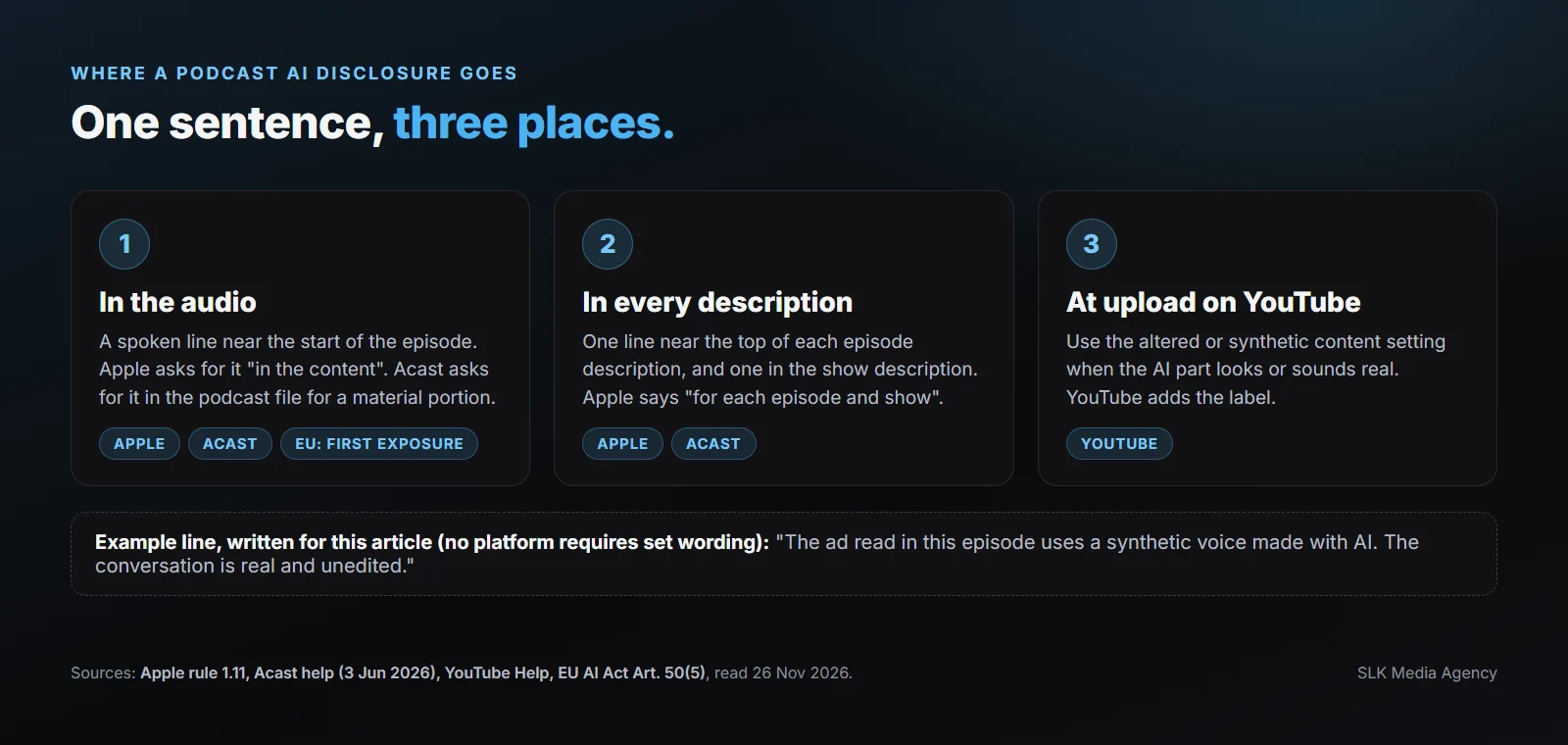
- Say it in the audio. Apple wants the disclosure "in the content". Acast wants it in the podcast file for a material portion. The EU rule asks for it at first exposure. A spoken line near the start covers all three.
- Write it in every episode description. Apple says "for each episode and show". Put one line near the top of each episode description and one in the show description.
- Use YouTube's setting. If you publish the video podcast or clips on YouTube, use the disclosure setting during upload when the AI part looks or sounds real.
Keep the line plain and specific. Name what was AI and leave out the rest. An example we wrote for this article, not wording any platform requires: "The ad read in this episode uses a synthetic voice made with AI. The conversation is real and unedited." Another: "This episode was translated and voiced with AI from our English original."
Avoid a blanket line such as "AI may have been used in this episode". It tells listeners nothing, and it can make them doubt the parts that are real.
How do listeners react to AI voices in podcasts?
The most direct data we found comes from Sounds Profitable. In a 24 September 2025 article, Tom Webster reported results from its Podcast Landscape 2025 survey of Americans aged 18 and over who had ever consumed a podcast. Asked about AI voices being introduced in a favorite show, 47% said they would be less likely to keep listening, including 28% who said much less likely. 21% said they would be more likely.
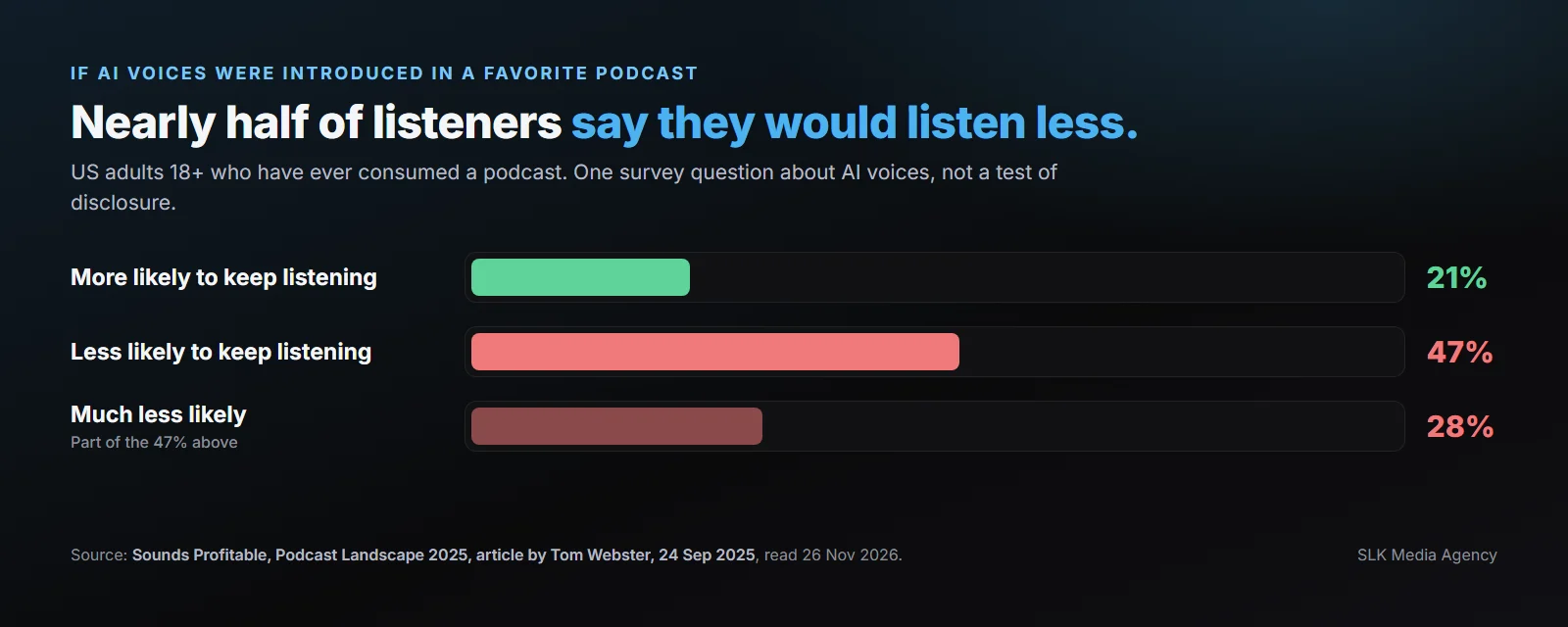
That is one survey question, not a test of disclosure itself. It does say something useful: a large share of listeners care whether the voice is human. That is a reason to tell them, apart from any rule.
There is also more AI content to stand apart from. On 15 April 2026 Podnews reported that 45.7% of new shows in the previous 24 hours were "potentially produced by AI", based on the Podcast Index New Feeds Report. That is one 24-hour window, and the share moves from day to day. If listeners are trying to tell real shows from AI feeds, a precise disclosure tells them which parts of yours are human.
What should a host do this week?
- List every AI tool in your production, from transcript to final export.
- Mark each one as text and cleanup, or audio and video. Only the second group needs a disclosure.
- For each audio or video use, check the table above for every platform your show is on. Apple is the strictest for listed shows.
- If any AI voice copies a real person, get written permission or stop using it.
- Add a spoken line and a description line to the next episode, and go back to the episodes already published with AI audio.
Many common AI uses are the exempt kind: drafting, transcripts, show notes, captions and cleanup. The disclosure duty starts when the AI becomes a voice or a face your audience meets. For more on where AI fits in clip work, see Why AI clipping tools pick the wrong moments.
This article is not legal advice. Rules are quoted from each platform's and the EU's own pages as read on 26 November 2026. Platforms change their rules, and Apple, YouTube and Spotify's rules pages show no date. Check the linked page before you rely on it, and ask a lawyer about the EU AI Act if your show reaches listeners in the EU.
Frequently asked questions
Do you need to disclose AI in your podcast?
If AI generated audio or video in the episode, such as a synthetic voice, an AI host or a cloned voice, Apple Podcasts requires a disclosure in the content and metadata of each episode and the show. Acast requires one when AI made a material portion or a realistic imitation, and YouTube when the content seems realistic. AI help with text and audio cleanup is not named as needing a label.
Does Apple Podcasts require AI disclosure?
Yes. Rule 1.11 of the Apple Podcasts Content Requirements says creators using AI to generate audio or video content, including synthetic voices, AI-generated hosts and AI replicas of real people, must prominently disclose it in the content and metadata for each episode and show. Rule 1.12 bans using AI to mislead.
Does Spotify require you to label AI in a podcast?
We found no AI disclosure rule for podcasts in Spotify's Platform Rules or its 19 May 2026 announcement. Spotify bans deceptive impersonation and harmful synthetic media presented as authentic, and says it will remove podcast shows that impersonate another creator or host's likeness without permission, including through AI voice cloning.
Do I need to disclose using ChatGPT or Claude to write my script or show notes?
Not on the platforms we read. YouTube lists using generative AI to create or improve an outline or script, captions and idea generation as exempt. Acast exempts captions. Apple's rule covers AI-generated audio or video. If a synthetic voice reads the AI script, that voice needs the disclosure.
Does the EU AI Act apply to podcasts?
Article 50 applies from 2 August 2026. It requires deployers to disclose audio or video that is a deep fake, meaning AI content that resembles real persons, places or events and would falsely appear authentic. A cloned voice of a real person fits that definition closely. Whether a made-up AI host voice counts is not settled in the sources we read. This is not legal advice.
Where should a podcast AI disclosure go?
In three places: a spoken line near the start of the episode, a line in every episode description and the show description, and YouTube's altered or synthetic content setting at upload when the AI part looks or sounds real. Apple asks for both the content and the metadata, for each episode and show.
Do listeners mind AI voices in podcasts?
Many say they do. In Sounds Profitable's Podcast Landscape 2025, reported on 24 September 2025, 47% of US adults who have consumed a podcast said they would be less likely to keep listening to a favorite show if AI voices were introduced, including 28% much less likely. 21% said more likely.
Sources
- Apple Podcasts for Creators: Apple Podcasts Content Requirements. Rule 1.11 Artificial Intelligence (AI) Generated Content and rule 1.12 Misleading Use of AI. The page shows no date; footer 2026. Read on 26 November 2026
- Acast: Use of AI in podcasting. Material portion and non-material realistic portion rules, exempt examples, ban on misleading use. Dated 3 June 2026. Read on 26 November 2026
- YouTube Help: Disclosing use of altered or synthetic content. When realistic AI content must be disclosed, the exempt list (outline, script, captions, ideas, filters, minor edits), where labels show and penalties. The page shows no date. Read on 26 November 2026
- YouTube Official Blog: How we're helping creators disclose altered or synthetic content. The original announcement of the disclosure requirement. Published 18 March 2024. Read on 26 November 2026
- Spotify: Platform Rules. Deceptive content: impersonation and manipulated or synthetic media presented as authentic. No AI disclosure rule. The page shows no date. Read on 26 November 2026
- Spotify Newsroom: Building a More Trusted Podcast Experience for Creators and Listeners. AI impersonation removal policy and Verified by Spotify badge criteria for podcasts. Published 19 May 2026. Read on 26 November 2026
- EU AI Act, Article 50: Transparency obligations (AI Act Explorer). Paragraph 4 on deep fakes, creative works and public-interest text; paragraph 5 on timing. Applies from 2 August 2026. Read on 26 November 2026
- EU AI Act, Article 3: Definitions (AI Act Explorer). Point 60, the definition of a deep fake. Read on 26 November 2026
- Goodwin Procter: EU AI Act transparency obligations now in force. Article 50 enforceable from 2 August 2026, fines up to EUR 15 million or 3% of worldwide annual turnover. Published 3 August 2026. Read on 26 November 2026
- Sounds Profitable (Tom Webster): How Do Humans Feel About AI Voices In Podcasting?. Podcast Landscape 2025: 47% less likely, 28% much less likely, 21% more likely to keep listening to a favorite show with AI voices. Published 24 September 2025. Read on 26 November 2026
- Podnews: More new AI-generated podcasts than human ones. 45.7% of new shows in one 24-hour window potentially produced by AI, from the Podcast Index New Feeds Report. Published 15 April 2026. Read on 26 November 2026

Claire Peter works on the growth team at SLK Media Agency, where the team edits, captions and posts short clips from podcast episodes every week. She writes about the habits that separate growing shows from stalled ones.